How to Get Your Business
Mentioned in AI Answers
The real competition is no longer just for rankings. It is for inclusion in the answer itself — and most businesses aren't ready.
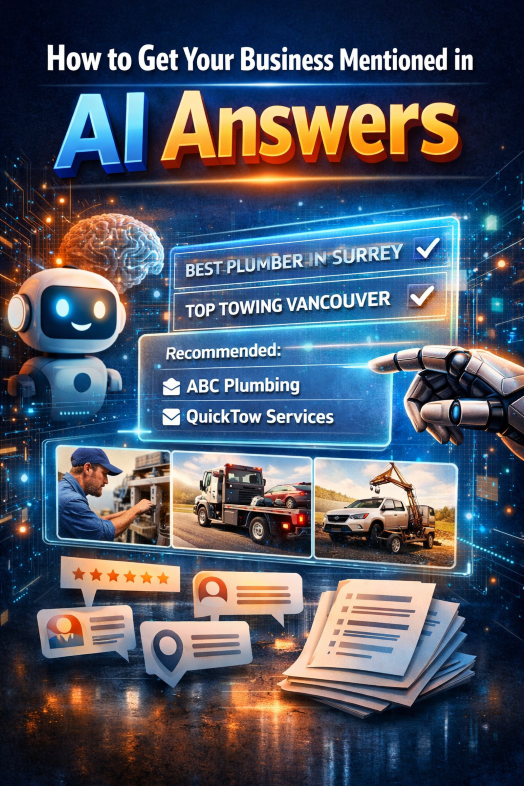
For years, SEO was about earning a click. Rank high enough, write a decent title tag, and hope the searcher chose you over nine other options. That model is changing fast. Today, more people are asking ChatGPT, Google's AI results, and other answer engines direct questions like "Who's the best plumber in Surrey?" or "What towing company in Vancouver is open right now?" In those moments, users are not browsing the web the way they used to. They are asking for a conclusion.
That means the real competition is no longer just for rankings. It is for inclusion in the answer itself. This is where many businesses fall behind. They still think visibility comes from stuffing pages with keywords, publishing thin blog posts, or copying what every competitor is doing. AI does not reward that. It looks for signals it can trust, summarize, and repeat with confidence.
If your website is vague, generic, or structurally weak, AI has no reason to mention you. To appear in AI answers, your business needs to become easy to understand, easy to validate, and easy to cite. In other words, you need to reduce the burden on the machine. The clearer your business is, the more likely AI is to surface it.
AI Does Not "Prefer" Websites — It Prefers Confidence
This is the shift most businesses miss. AI systems are not trying to be fair. They are trying to be useful. When someone asks a question, the model looks for the most probable, defensible answer based on the information it can access and interpret. That means your goal is not simply to have a website. Your goal is to create digital signals strong enough that an AI system can confidently say, "This business appears relevant, credible, and worth mentioning."
That confidence comes from pattern consistency. If your site says one thing, your Google Business Profile says another, and your reviews barely mention your actual services or cities, your business looks weak. But when your website, citations, reviews, local pages, FAQs, and service descriptions all reinforce the same story, your business becomes much easier for AI to trust.
AI answers often come from synthesis, not discovery. If the web already agrees on who you are, what you do, and where you do it, you are far more likely to be included.
Your Website Needs to Answer Buying Questions, Not Just Describe Services
Most service business websites are written like brochures. They say things like, "We offer high-quality towing services" or "We are a trusted local plumber." That language is invisible. It is too broad, too safe, and too similar to everything else online. AI is not looking for self-praise. It is looking for useful distinctions.
A stronger page does not just describe the service. It answers the questions a customer would ask right before making a decision. For example, a towing page should answer things like: Do you offer accident towing? How fast can you reach East Vancouver? Do you tow lowered vehicles? What happens if the car will not shift into neutral? A plumbing page should answer: Do you handle emergency pipe bursts? Are you available evenings? What neighborhoods in Surrey do you cover? What should a homeowner do before the plumber arrives?
These are the kinds of details that make your content quotable. AI needs substance, not slogans.
AI Mentions Are Earned Through Specificity
Generic businesses are easy to ignore. Specific businesses are easy to recommend. To be mentioned in AI answers, you need to become more specific than your competitors in three areas:
Service Specificity
"Towing" becomes accident towing, flatbed towing, underground parking recovery, motorcycle towing, long-distance towing, and scrap car pickup. "Plumbing" becomes emergency plumbing, drain cleaning, hot water tank replacement, leak detection, sump pump repair, and sewer line camera inspections.
Geographic Specificity
Proving exactly where you work. Not just "Metro Vancouver," but Burnaby, Surrey, Cloverdale, Newton, South Surrey, Langley, Coquitlam, Port Coquitlam, Maple Ridge, and more. AI answers often respond to local context. A business that clearly demonstrates city and neighborhood relevance has a much stronger chance of being surfaced.
Scenario Specificity
Writing for real-world moments. Someone needing scrap car removal in Mission may have a dead truck in the driveway, an inherited vehicle on a rural property, or an old RV that has not moved in years. When your content reflects actual customer situations, it becomes more useful to both humans and AI.
Reviews Matter More Than Most Businesses Realize

If AI is going to mention a business, it wants reinforcement from outside the business itself. Reviews play a powerful role here because they are independent language signals. They often contain the exact phrases customers use naturally: "same-day towing in Vancouver," "helped with our blocked drain in Surrey," "picked up our old car from Mission," "great daycare in Abbotsford." That language is gold.
Most businesses treat reviews as reputation assets only. In reality, they are also semantic assets. They help confirm what your business actually does, where you do it, and how customers experience it. A business with dozens of detailed, location-rich, service-specific reviews has a stronger digital footprint than one with a handful of vague five-star ratings.
It is not just that people like you. It is that the web keeps describing you in a consistent, believable way.
Authority Is No Longer Just About Backlinks
Backlinks still matter, but AI visibility is broader than classic SEO authority. A business can have decent rankings and still not be mentioned much in AI answers if its content lacks structure or real-world usefulness. Authority now includes explainability.
Can your website explain what you do in plain language? Can it distinguish you from the dozens of businesses using the same generic phrases? Does it show evidence of real experience? Does it demonstrate operational reality — service areas, timelines, process, pricing approach, equipment, credentials, or case examples?
That means service pages should stop sounding like empty marketing and start sounding like actual expertise. A scrap car removal business should talk about towing non-running vehicles, handling ownership paperwork, picking up from driveways, back lanes, farms, and commercial lots, and accepting cars, trucks, forklifts, RVs, buses, tractors, and machinery.
A business becomes more mentionable when it sounds like it has done the work, not just advertised it.
Structure Is Strategy
A lot of businesses lose AI visibility because their websites are structurally lazy. They pile everything onto a few pages, use weak headings, bury important details, and assume that if the information exists somewhere, it will be found. AI does not work well with buried meaning. It rewards strong information architecture.
Think of structure as a form of respect. You are respecting the visitor's time and the AI's need for clarity. A well-structured site reduces confusion, and reduced confusion increases the odds of being mentioned.
The Businesses That Win Will Be the Easiest to Summarize
This is the simplest way to think about AI search. The winners will not necessarily be the loudest businesses. They will be the easiest businesses to summarize accurately. If an AI system had to explain your company in two sentences, could it do that clearly? Could it say what you do, where you do it, why people choose you, and what makes you distinct?
If the answer is no, your digital presence is probably too muddy. Businesses that show up in AI answers usually have a strong, repeatable identity online. They are not trying to say everything. They are saying the right things clearly and repeatedly across pages, profiles, citations, and reviews.
Final Thought

Getting your business mentioned in AI answers is not about gaming a new platform. It is about building a business presence that is structured, credible, and specific enough to be confidently recommended. That is a higher standard than old-school SEO, but it is also a better one. It rewards clarity over clutter, expertise over fluff, and consistency over guesswork.
The Burden Marketing Perspective
The burden is no longer just ranking. It is becoming recognizable, trustworthy, and answer-worthy.
At Burden Marketing, we see this as the next evolution of search. Businesses that understand this now will have a major advantage as search continues to shift. We carry the complexity — so you can focus on being found.